The Social Shift: How We Redefined Disability Through History
by Sabina Jisu Hur
The Social Shift: How We Redefined Disability Through History
How did people who were deemed “unfit” in society, who were controlled and erased, fight for inclusion and rights?
How do these ideas still influence our society today?
Trigger Warnings include: Eugenics and genetic discrimination. Racism, sexism, homophobia, and transphobia. References to the Holocaust and systemic violence.
Written by Sabina Jisu Hur
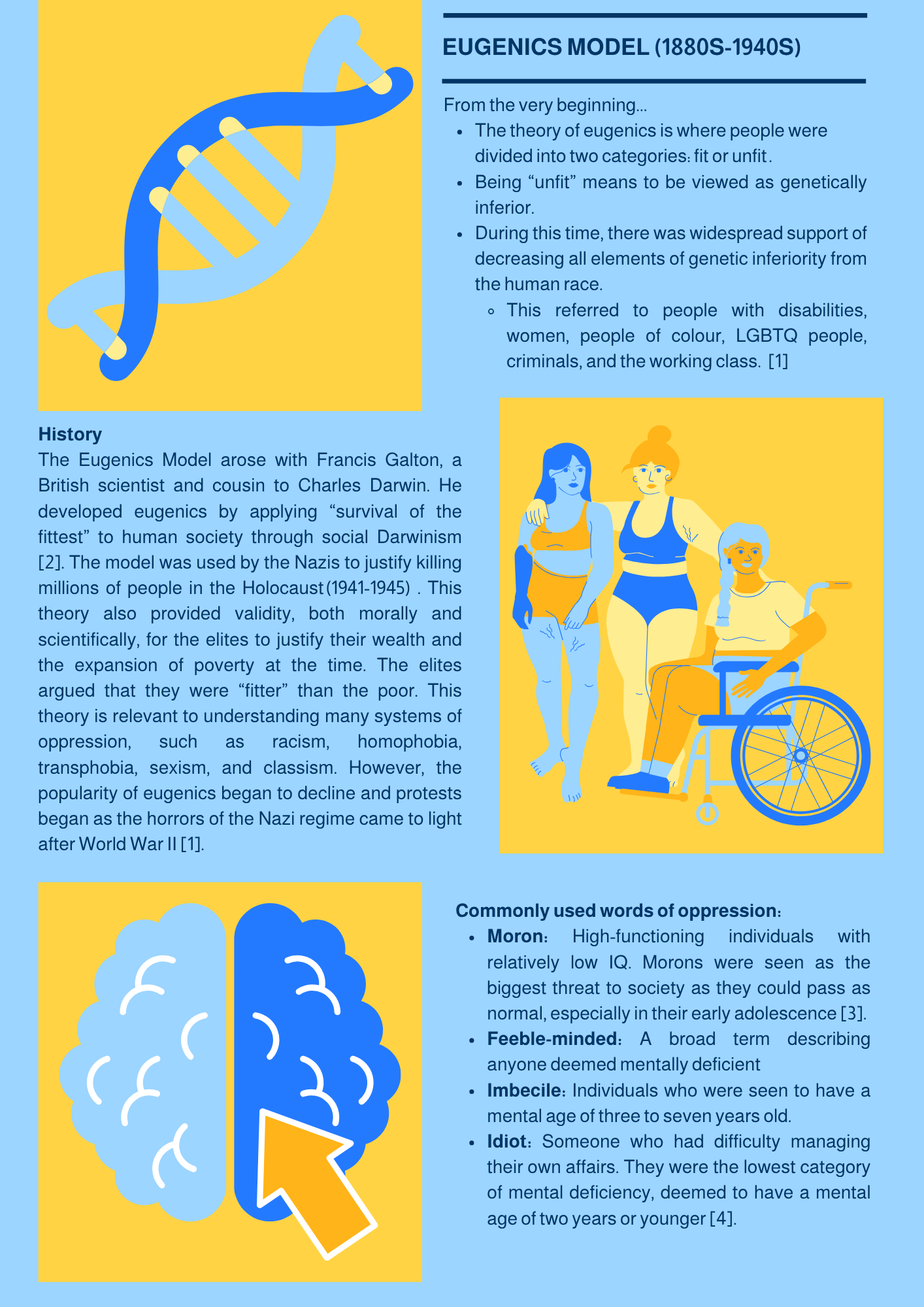
Eugenics model (1880s-1940s):
From the very beginning... The theory of eugenics is where people were divided into two categories: fit or unfit . Being “unfit” means to be viewed as genetically inferior. During this time, there was widespread support of decreasing all elements of genetic inferiority from the human race. This referred to people with disabilities, women, people of colour, LGBTQ people, criminals, and the working class. [1]
History
The Eugenics Model arose with Francis Galton, a British scientist and cousin to Charles Darwin. He developed eugenics by applying “survival of the fittest” to human society through social Darwinism [2]. The model was used by the Nazis to justify killing millions of people in the Holocaust (1941-1945) . This theory also provided validity, both morally and scientifically, for the elites to justify their wealth and the expansion of poverty at the time. The elites argued that they were “fitter” than the poor. This theory is relevant to understanding many systems of oppression, such as racism, homophobia, transphobia, sexism, and classism. However, the popularity of eugenics began to decline and protests began as the horrors of the Nazi regime came to light after World War II [1].
Commonly used words of oppression:
Moron: High-functioning individuals with relatively low IQ. Morons were seen as the biggest threat to society as they could pass as normal, especially in their early adolescence [3]. Feeble-minded: A broad term describing anyone deemed mentally deficient Imbecile: Individuals who were seen to have a mental age of three to seven years old. Idiot: Someone who had difficulty managing their own affairs. They were the lowest category of mental deficiency, deemed to have a mental age of two years or younger [4].
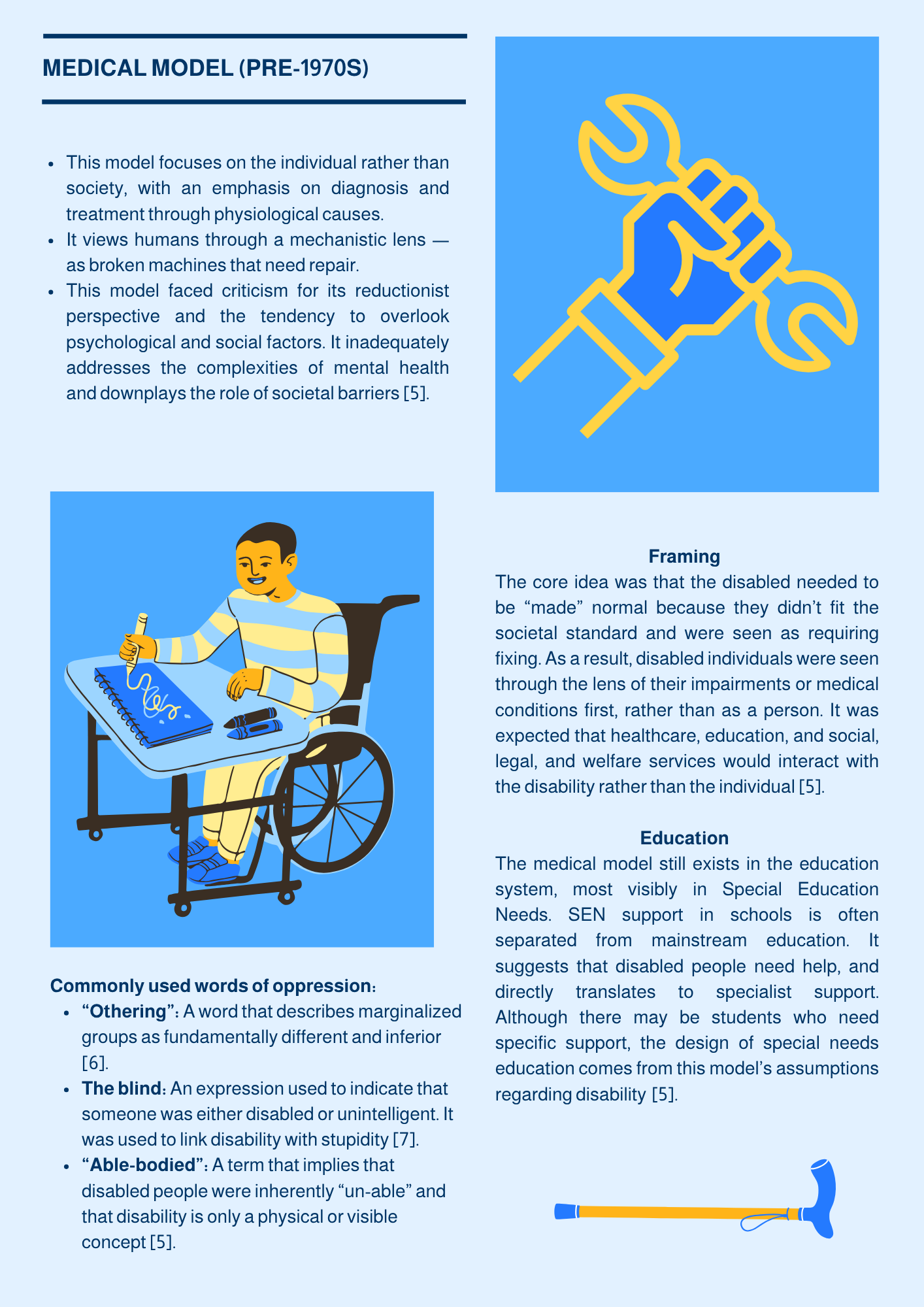
Medical Model (Pre-1970s):
This model focuses on the individual rather than society, with an emphasis on diagnosis and treatment through physiological causes. It views humans through a mechanistic lens — as broken machines that need repair. This model faced criticism for its reductionist perspective and the tendency to overlook psychological and social factors. It inadequately addresses the complexities of mental health and downplays the role of societal barriers [5].
Framing
The core idea was that the disabled needed to be “made” normal because they didn’t fit the societal standard and were seen as requiring fixing. As a result, disabled individuals were seen through the lens of their impairments or medical conditions first, rather than as a person. It was expected that healthcare, education, and social, legal, and welfare services would interact with the disability rather than the individual [5].
Education
The medical model still exists in the education system, most visibly in Special Education Needs. SEN support in schools is often separated from mainstream education. It suggests that disabled people need help, and directly translates to specialist support. Although there may be students who need specific support, the design of special needs education comes from this model’s assumptions regarding disability [5].
Commonly used words of oppression:
“Othering”: A word that describes marginalized groups as fundamentally different and inferior [6]. The blind: An expression used to indicate that someone was either disabled or unintelligent. It was used to link disability with stupidity [7]. “Able-bodied”: A term that implies that disabled people were inherently “un-able” and that disability is only a physical or visible concept [5].
Tragedy/charity model:
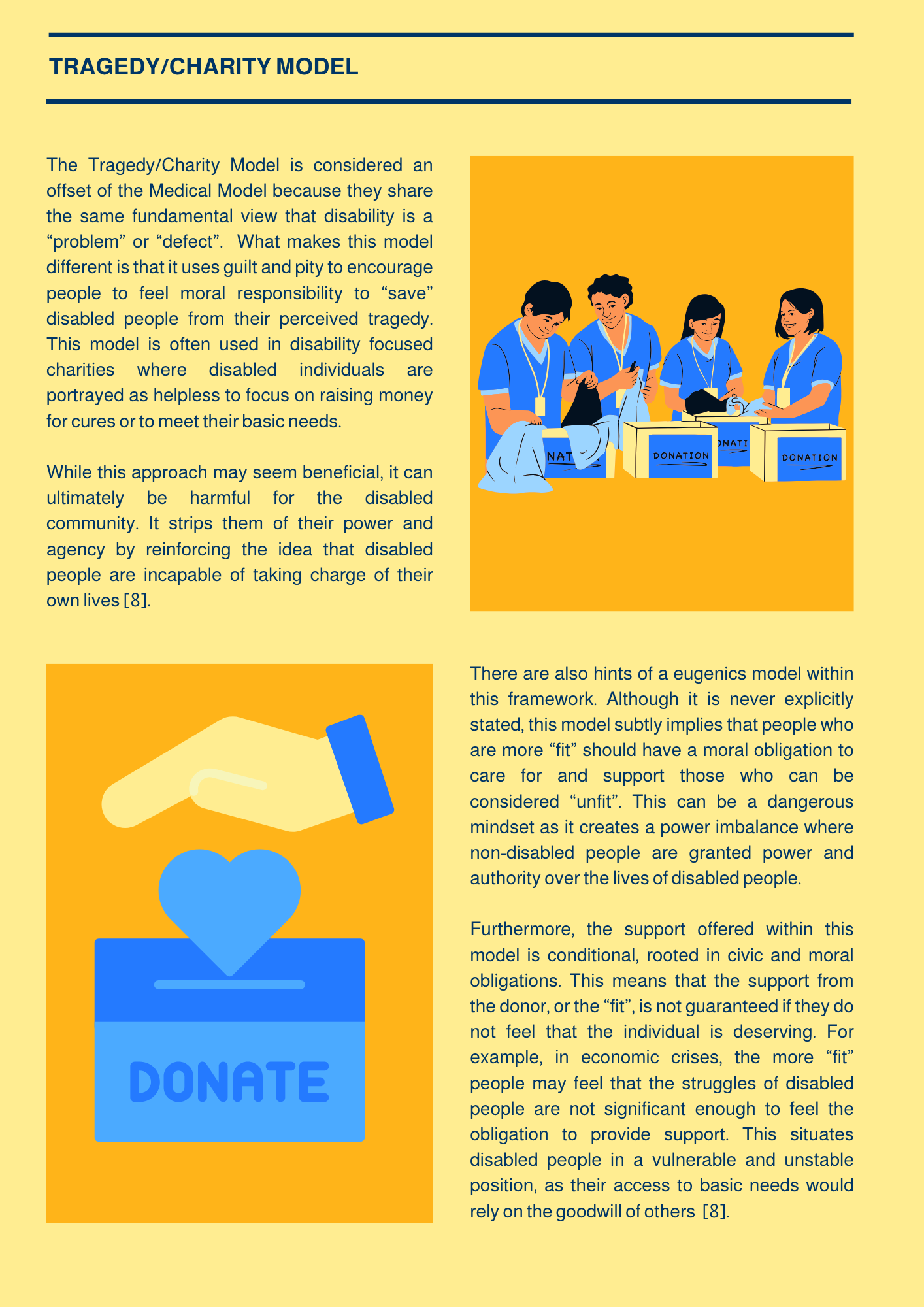
The Tragedy/Charity Model is considered an offset of the Medical Model because they share the same fundamental view that disability is a “problem” or “defect”. What makes this model different is that it uses guilt and pity to encourage people to feel moral responsibility to “save” disabled people from their perceived tragedy. This model is often used in disability focused charities where disabled individuals are portrayed as helpless to focus on raising money for cures or to meet their basic needs.
While this approach may seem beneficial, it can ultimately be harmful for the disabled community. It strips them of their power and agency by reinforcing the idea that disabled people are incapable of taking charge of their own lives [8].
There are also hints of a eugenics model within this framework. Although it is never explicitly stated, this model subtly implies that people who are more “fit” should have a moral obligation to care for and support those who can be considered “unfit”. This can be a dangerous mindset as it creates a power imbalance where non-disabled people are granted power and authority over the lives of disabled people.
Furthermore, the support offered within this model is conditional, rooted in civic and moral obligations. This means that the support from the donor, or the “fit”, is not guaranteed if they do not feel that the individual is deserving. For example, in economic crises, the more “fit” people may feel that the struggles of disabled people are not significant enough to feel the obligation to provide support. This situates disabled people in a vulnerable and unstable position, as their access to basic needs would rely on the goodwill of others [8].
Social Model (1970s–2000s):
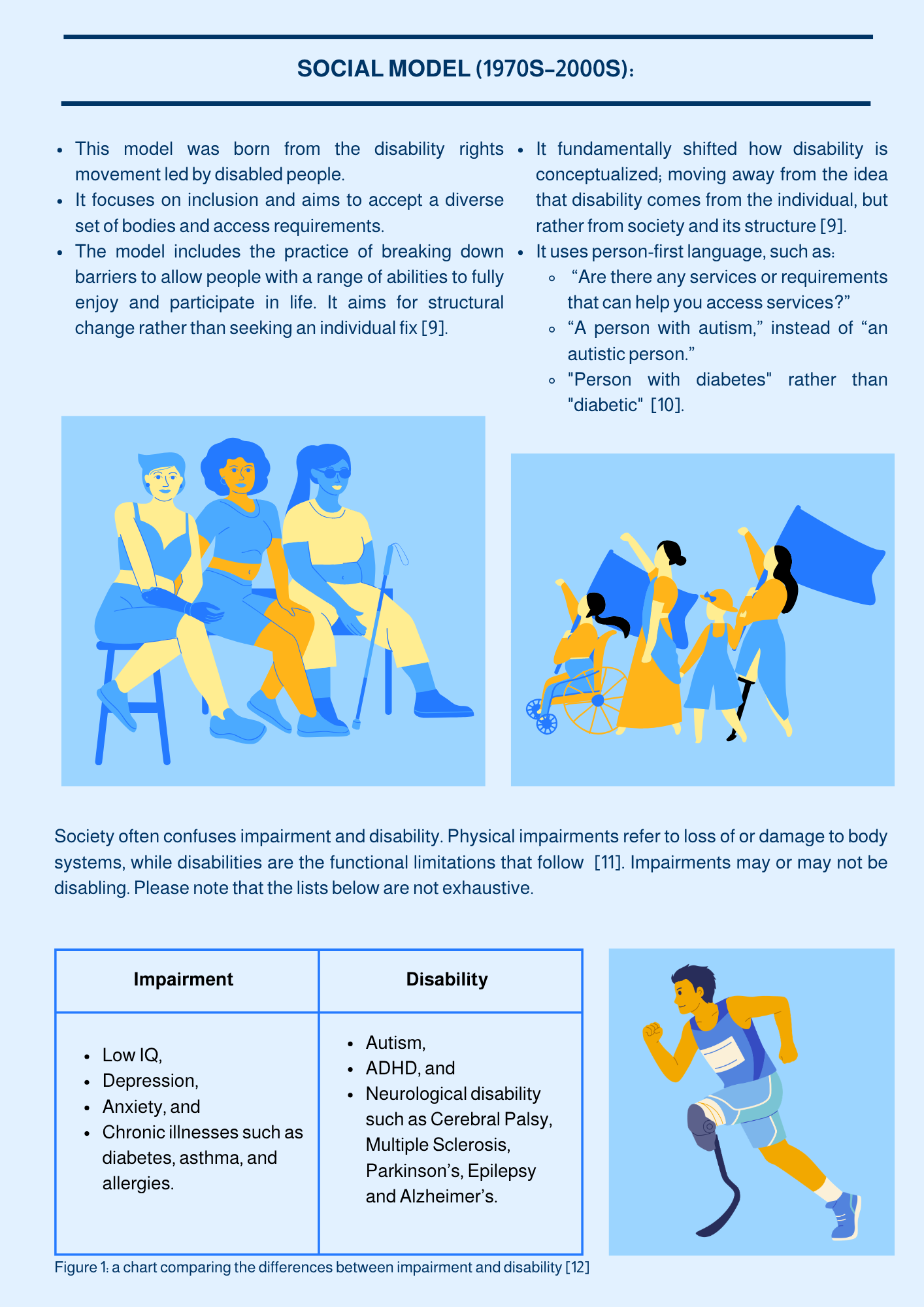
This model was born from the disability rights movement led by disabled people. It focuses on inclusion and aims to accept a diverse set of bodies and access requirements. The model includes the practice of breaking down barriers to allow people with a range of abilities to fully enjoy and participate in life. It aims for structural change rather than seeking an individual fix [9]. It fundamentally shifted how disability is conceptualized; moving away from the idea that disability comes from the individual, but rather from society and its structure [9]. It uses person-first language, such as: “Are there any services or requirements that can help you access services?”, “A person with autism,” instead of “an autistic person.”, "Person with diabetes" rather than "diabetic" [10].
Society often confuses impairment and disability. Physical impairments refer to loss of or damage to body systems, while disabilities are the functional limitations that follow [11]. Impairments may or may not be disabling. Please note that the lists below are not exhaustive.
Impairment: Low IQ, Depression, Anxiety, and Chronic illnesses such as diabetes, asthma, and allergies.
Disability: Autism, ADHD, and Neurological disability such as Cerebral Palsy, Multiple Sclerosis, Parkinson’s, Epilepsy and Alzheimer’s.
The radical model (Present):
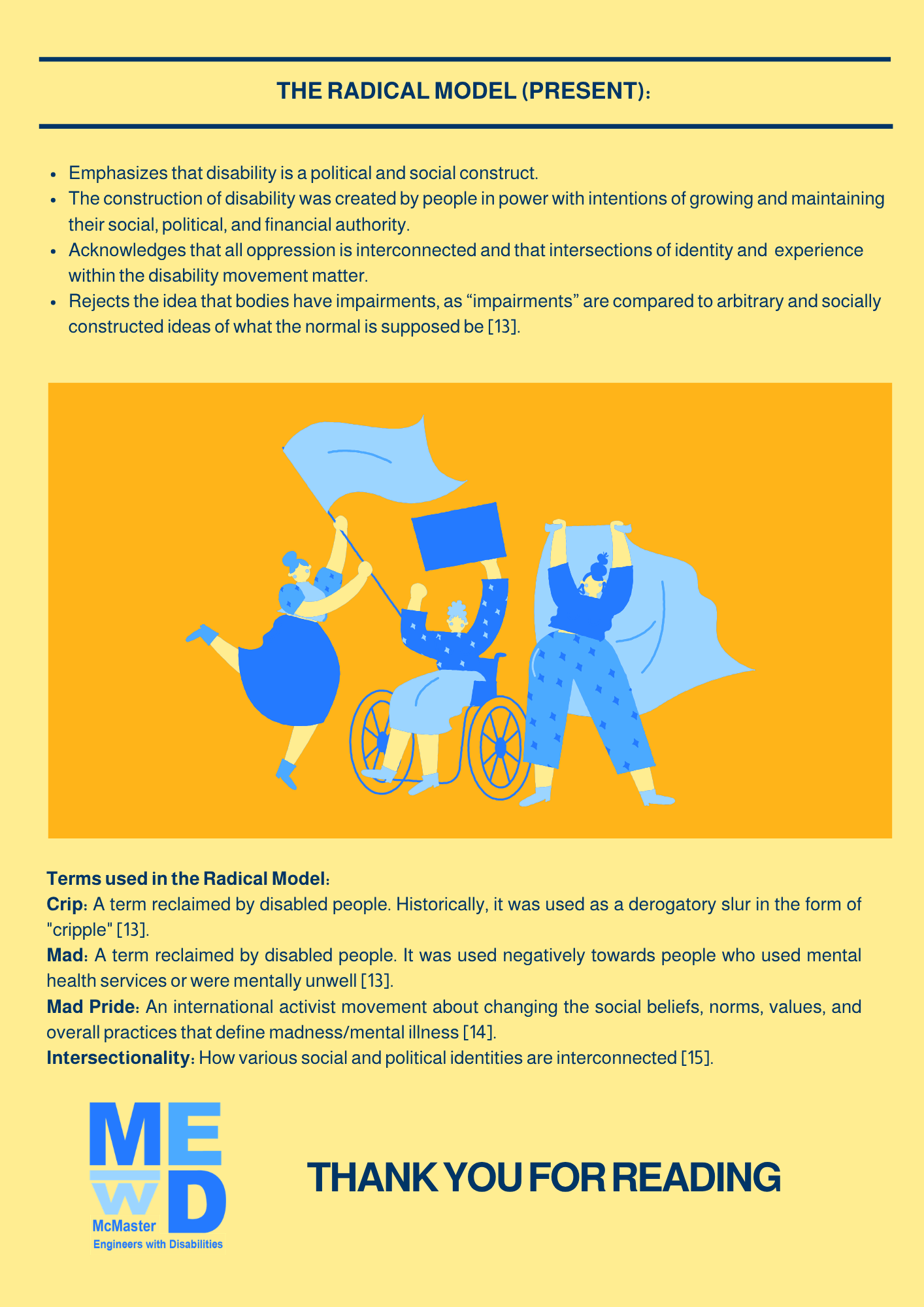
Emphasizes that disability is a political and social construct. The construction of disability was created by people in power with intentions of growing and maintaining their social, political, and financial authority. Acknowledges that all oppression is interconnected and that intersections of identity and experience within the disability movement matter. Rejects the idea that bodies have impairments, as “impairments” are compared to arbitrary and socially constructed ideas of what the normal is supposed be [13].
Terms used in the Radical Model:
Crip: A term reclaimed by disabled people. Historically, it was used as a derogatory slur in the form of "cripple" [13]. Mad: A term reclaimed by disabled people. It was used negatively towards people who used mental health services or were mentally unwell [13]. Mad Pride: An international activist movement about changing the social beliefs, norms, values, and overall practices that define madness/mental illness [14]. Intersectionality: How various social and political identities are interconnected [15].
Citations
[1] “Sticks and Stones: The Language of Disability.” SPECTRUM Centre for Independent Living, Feb. 2018.
[2] “Understanding Disability: Part 2 – The Eugenics Model | Drake Music.” Accessed: Mar. 27, 2026. [Online]. Available: https://www.drakemusic.org/blog/nim-ralph/understanding-disability-part-2-the-eugenics-model/
[3] “Eugenics | Definition, History, & Facts | Britannica.” Accessed: Mar. 27, 2026. [Online]. Available: https://www.britannica.com/science/eugenics-genetics
[4] “Henry Herbert Goddard (1866–1957) | Embryo Project Encyclopedia.” Accessed: Mar. 27, 2026. [Online]. Available: https://embryo.asu.edu/pages/henry-herbert-goddard-1866-1957
[5] “The Clinical History of ‘Moron,’ ‘Idiot,’ and ‘Imbecile.’” Accessed: Mar. 27, 2026. [Online]. Available: https://www.merriam-webster.com/wordplay/moron-idiot-imbecile-offensive-history
[6] “Understanding Disability: Part 3 – The Medical Model | Drake Music.” Accessed: Mar. 27, 2026. [Online]. Available: https://www.drakemusic.org/blog/nim-ralph/understanding-disability-part-3-the-medical-model/
[7] A. Marsh, M. A. Marsh, MD, I. a B.-C. Child, adolescent, and adult psychiatrist who has dedicated his career to working with medically underserved communities L. about our R. Board, “How Othering Contributes to Discrimination and Prejudice,” Verywell Mind. Accessed: Mar. 27, 2026. [Online]. Available: https://www.verywellmind.com/what-is-othering-5084425
[8] “Ableist Language To Avoid And Acceptable Alternatives – ‘Blind’ Edition,” The Rolling Explorer. Accessed: Mar. 27, 2026. [Online]. Available: https://therollingexplorer.com/ableist-language-to-avoid-and-acceptable-alternatives-blind-edition/
[9] “Understanding Disability: Part 4 – The Charity Model | Drake Music.” Accessed: Mar. 27, 2026. [Online]. Available: https://www.drakemusic.org/blog/nim-ralph/understanding-disability-part-4-the-charity-model/
[10] “Understanding Disability: Part 5 – The Social Model | Drake Music.” Accessed: Mar. 27, 2026. [Online]. Available: https://www.drakemusic.org/blog/nim-ralph/understanding-disability-part-5-the-social-model/
[11] “Person-first and Destigmatizing Language | National Institutes of Health (NIH).” Accessed: Mar. 27, 2026. [Online]. Available: https://www.nih.gov/nih-style-guide/person-first-destigmatizing-language
[12] CDC, “Disability and Health Overview,” Disability and Health. Accessed: Mar. 27, 2026. [Online]. Available: https://www.cdc.gov/disability-and-health/about/index.html
[13] “Understanding Disability: Part 6 – The Radical Model | Drake Music.” Accessed: Mar. 27, 2026. [Online]. Available: https://www.drakemusic.org/blog/nim-ralph/understanding-disability-part-6-the-radical-model/
[14] “Peer support, mad pride and disability justice,” www.counseling.org. Accessed: Mar. 27, 2026. [Online]. Available: https://www.counseling.org/publications/counseling-today-magazine/article-archive/article/legacy/peer-support-mad-pride-and-disability-justice
[15] “Intersectionality | Definition, Kimberle Crenshaw, History, Applications, Criticism, & Facts | Britannica.” Accessed: Mar. 27, 2026. [Online]. Available: https://www.britannica.com/topic/intersectionality